
Signs and symptoms of autoimmune type 1 diabetes
In autoimmune type 1 diabetes, the body mistakenly attacks insulin-producing beta cells of the pancreas, leading to high levels of blood glucose.1
What are the signs and symptoms of autoimmune type 1 diabetes?
Along with symptoms, autoimmune type 1 diabetes can result in a medical emergency called diabetic ketoacidosis (DKA) if not identified early. Screening can help identify people with presymptomatic autoimmune type 1 diabetes and prevent medical emergencies.
Common symptoms of autoimmune type 1 diabetes:
Increased hunger (polyphagia)
The body uses glucose from food and drinks as one of the main energy sources. Insulin helps the cells take up glucose from the bloodstream.2 The lack of insulin in type 1 diabetes means that the cells consume glucose less effectively, and as a consequence, the cells starve. You may notice this by feeling more hungry than usual.
Fatigue or weakness
Several factors may contribute to fatigue and weakness in people with type 1 diabetes. Changing glucose levels, nerve pain, and sleep problems all contribute to exhaustion and can cause fatigue and muscle weakness.3,4
Blurred vision
Irregularly high blood glucose in people with type 1 diabetes damages blood vessels all over the body. Injuries to the blood vessels in the eye can lead to vision problems.5,6
Slow-healing wounds
Type 1 diabetes disturbs important processes for normal wound healing, such as inflammation and blood circulation.7 As a consequence, wounds may heal more slowly than usual.
Frequent infections
Increased blood glucose levels also harm the body’s defence system against bacteria and viruses, making people with type 1 diabetes more likely to get infections.8
Frequent urination (polyuria) and excessive thirst (polydipsia)
In autoimmune type 1 diabetes, the kidneys produce more urine to try to clear the excess glucose from the body.2 This makes you pee more frequently than usual. The loss of fluid then makes you more thirsty than usual.
Unexplained weight loss
Unexplained weight loss is one of the most common symptoms of autoimmune type 1 diabetes. As the body cannot feed its cells with glucose sufficiently,2 the body breaks down fat and muscle for energy to compensate, leading to weight loss.
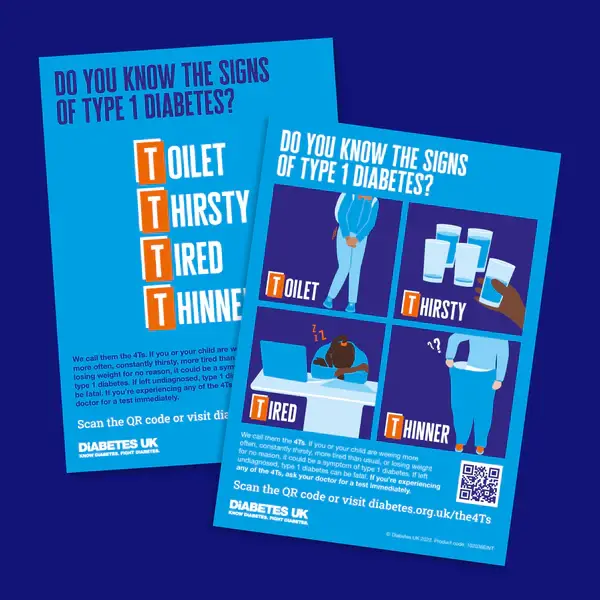
Recognize the warning signs of autoimmune type 1 diabetes with the 4 Ts of type 1 diabetes:9
What are the red flag autoimmune type 1 diabetes symptoms?
Red flag symptoms are those that require immediate medical attention. If you or your child experiences any symptoms of type 1 diabetes, talk to a medical professional immediately.
Red flag symptoms in autoimmune type 1 diabetes can be a sign of autoimmune type 1 diabetes complications, such as diabetic ketoacidosis (DKA).9,10 Watch out for warning signs of these complications:9,10
- a fruity-smelling breath similar to the smell of nail polish remover or drop sweets
- rapid breathing
- nausea or vomiting
- severe fatigue
- confusion
Learn more about the potential complications of type 1 diabetes
What are the symptoms of autoimmune type 1 diabetes in children compared to adults?
Autoimmune type 1 diabetes can occur at any age, with symptoms slightly differing in children and adults.11 In children, the effects of autoimmune type 1 diabetes on the body include, for instance, bedwetting, irritability, and/or unusual behaviour.9 Whilst in adults, symptoms can be similar to those caused by type 2 diabetes, making the diagnosis more challenging.12
What are the symptoms of autoimmune type 1 diabetes in men compared to women?
Women and men can experience autoimmune type 1 diabetes differently in terms of symptoms and likelihood of certain complications.13–15
Women with autoimmune type 1 diabetes have a higher chance of experiencing cardiovascular (heart) and kidney problems.16 Women also have higher rates of additional autoimmune diseases, such as autoimmune thyroid disease and rheumatoid arthritis, making complications more likely.15
In men, autoimmune type 1 diabetes is more frequently associated with reduced muscle mass than in women.17
What triggers the onset of autoimmune type 1 diabetes symptoms?
Autoimmune type 1 diabetes is a complex disease and can take years to develop before the first symptoms appear. The exact triggers of the condition are currently unknown, although a combination of genetic and environmental factors is thought to cause autoimmune type 1 diabetes.1
Learn more about how autoimmune type 1 diabetes works
What to do if you recognize symptoms of autoimmune type 1 diabetes in you or your child?
If you recognize autoimmune type 1 diabetes symptoms in yourself or your child, talk to a healthcare provider. Seek immediate medical help when you notice red flag symptoms.
Autoimmune type 1 diabetes is often first diagnosed following a medical emergency.9 This doesn’t need to be the case.
Early detection of autoimmune type 1 diabetes through screening can identify individuals with an increased chance of developing the condition before type 1 diabetes symptoms appear and provides a better way to be introduced to living with the condition than through a medical emergency.9,17–19
Some individuals with a family history of autoimmune type 1 diabetes or autoimmune diseases, such as celiac or thyroid disease, have an increased chance of developing autoimmune type 1 diabetes.18 For these people, screening is strongly recommended.
Learn more about the screening for autoimmune type 1 diabetes.
References
- Katsarou A, Gudbjörnsdottir S, Rawshani A, et al. Type 1 diabetes mellitus. Nat Rev Dis Primers. 2017;3(1):17016. doi:10.1038/nrdp.2017.16
- Kahanovitz L, Sluss PM, Russell SJ. Type 1 diabetes - A clinical perspective. Point Care. 2017;16(1):37-40. doi:10.1097/POC.0000000000000125
- Griggs S, Morris NS. Fatigue among adults with type 1 diabetes mellitus and implications for self-management: An integrative review. Diabetes Educ. 2018;44(4):325-339. doi:10.1177/0145721718782148
- Lien ASY, Hwang JS, Jiang YD. Diabetes related fatigue sarcopenia, frailty. J Diabetes Investig. 2018;9(1):3-4. doi:10.1111/jdi.12752
- Fung TH, Patel B, Wilmot EG, Amoaku WM. Diabetic retinopathy for the non-ophthalmologist. Clin Med. 2022;22(2):112-116. doi:10.7861/clinmed.2021-0792
- CDC. Vision Loss and. Diabetes. June 10, 2024. Accessed May 21, 2025. https://www.cdc.gov/diabetes/diabetes-complications/diabetes-and-vision-loss.html
- Dasari N, Jiang A, Skochdopole A, et al. Updates in diabetic wound healing, inflammation, and scarring. Semin Plast Surg. 2021;35(3):153-158. doi:10.1055/s-0041-1731460
- Zhou K, Lansang MC. Diabetes mellitus and infection. In: Endotext. MDText.com, Inc.; 2000. Accessed May 21, 2025. https://www.ncbi.nlm.nih.gov/books/NBK569326/
- Usher-Smith JA, Thompson MJ, Zhu H, Sharp SJ, Walter FM. The pathway to diagnosis of type 1 diabetes in children: a questionnaire study. BMJ Open. 2015;5(3):e006470. doi:10.1136/bmjopen-2014-006470
- Jackman J, Chafe R, Albrechtsons D, et al. Delayed diagnosis and issues with pump usage are the leading causes of diabetic ketoacidosis in children with diabetes living in Newfoundland and Labrador, Canada. BMC Res Notes. 2015;8(1):158. doi:10.1186/s13104-015-1115-y
- Chiang JL, Maahs DM, Garvey KC, et al. Type 1 diabetes in children and adolescents: A position statement by the American diabetes association. Diabetes Care. 2018;41(9):2026-2044. doi:10.2337/dci18-0023
- Symptoms & Causes of Diabetes. National Institute of Diabetes and Digestive and Kidney Diseases. December 27, 2024. Accessed May 13, 2025. https://www.niddk.nih.gov/health-information/diabetes/overview/symptoms-causes
- Bak JCG, Serné EH, de Valk HW, et al. Gender gaps in type 1 diabetes care. Acta Diabetol. 2023;60(3):425-434. doi:10.1007/s00592-022-02023-6
- Tatti P, Pavandeep S. Gender difference in type 1 diabetes: An underevaluated dimension of the disease. Diabetology. 2022;3(2):364-368. doi:10.3390/diabetology3020027
- Rogers MAM, Wei MY, Kim C, Lee JM. Sex differences in autoimmune multimorbidity in type 1 diabetes mellitus and the risk of cardiovascular and renal disease: A longitudinal study in the United States, 2001-2017. J Womens Health (Larchmt). 2020;29(4):511-519. doi:10.1089/jwh.2019.7935
- Rawshani A, Sattar N, Franzén S, et al. Excess mortality and cardiovascular disease in young adults with type 1 diabetes in relation to age at onset: a nationwide, register-based cohort study. Lancet. 2018;392(10146):477-486. doi:10.1016/S0140-6736(18)31506-X
- Andreo-López MC, Zarco-Martín MT, Contreras-Bolívar V, Fernández-Soto ML. Prevalence of sarcopenia and dynapenia and related clinical outcomes in patients with type 1 diabetes mellitus. Nutrients. 2023;15(23):4914. doi:10.3390/nu15234914
- Popoviciu MS, Kaka N, Sethi Y, Patel N, Chopra H, Cavalu S. Type 1 Diabetes Mellitus and autoimmune diseases: A critical review of the association and the application of personalized medicine. J Pers Med. 2023;13(3). doi:10.3390/jpm13030422