

Have you been
screened for type 1
diabetes?
Learn how screening can detect type 1 diabetes before symptoms show1,2
Get ahead of type 1 diabetes with screening
Type 1 diabetes doesn’t appear overnight, it develops slowly over time. Because the earliest stages are ‘silent’, with no visible symptoms, it’s actually very common to live with the condition long before you realise you have it.1,3,4
The good news is that screening can help detect type 1 diabetes early. A quick finger-prick test at home, or a standard blood draw at a clinic, checks your blood for specific proteins called autoantibodies, which are detectable long before symptoms appear.4,5
Autoantibody screening is different from a blood glucose test, which measures blood glucose (sugar) levels.6 Autoantibody screening checks your blood for the early warning signs of type 1 diabetes,7 so action can be taken to manage the condition as early as possible.

Getting screened is an effective step towards protecting your health, and finding type 1 diabetes in its earliest stages brings some important benefits.
Screening:
- gives you and your family valuable time to adjust, learn and connect with other people going through the same experience
- reduces the stress and anxiety that often comes with a sudden, unexpected diagnosis of later-stage (Stage 3) type 1 diabetes4,8
- helps you and your doctor look out for any changes to your health before the situation becomes more serious4,8
How type 1 diabetes screening works
Screening works by checking for proteins in the blood called autoantibodies.

It starts with a quick finger-prick test or a standard blood draw. You can do this using a home testing kit or by visiting a clinic.
Your sample is then sent off to a laboratory, where it is carefully checked for autoantibodies.

Think of autoantibodies as early warning signs. In type 1 diabetes, they are
created when your immune system gets confused and mistakenly starts attacking your insulin-producing beta cells. If autoantibodies are detected in your blood, this shows that you have started to develop type 1 diabetes, even though you don’t have any symptoms yet.1,9,10
Click here to find out more about autoantibodies
By checking for these specific autoantibodies, screening can tell you:
- whether you have early-stage type 1 diabetes1,11
- your risk of developing type 1 diabetes in the future3

You can expect to receive your results within a few days or weeks.

If the lab finds multiple different autoantibodies, or specific combinations of autoantibodies, it can mean you have a higher chance of developing Stage 3 type 1 diabetes in the future.1,2

You’re not in this alone. Your doctor will walk you through exactly what your results mean and help you prepare for the next steps.
Type 1 diabetes screening in children
Could your child be at risk of developing type 1 diabetes? Many parents think their child is ‘too young’ or ‘too old’ to get type 1 diabetes, but the truth is, it can develop at any age, including in babies and toddlers.12
Asking your doctor about screening is an excellent way to get ahead and give you and your child time to prepare, especially if either of the following apply:
- Someone in your family (such as a sibling, grandparent, aunt, uncle, or cousin) has type 1 diabetes8,13-15
- They, or someone in the family has an autoimmune condition, like coeliac disease or an autoimmune thyroid condition16-19

While family history can play a big role in your child’s risk of developing type 1 diabetes, it’s certainly not the only factor. 9 out of 10 people who develop type 1 diabetes actually have no family history of the condition. 20
Screening for type 1 diabetes gives you, your child and your doctor a real head start. Finding it early helps avoid serious medical emergencies in the future, such as diabetic ketoacidosis (DKA), and lets your child simply focus on enjoying life.

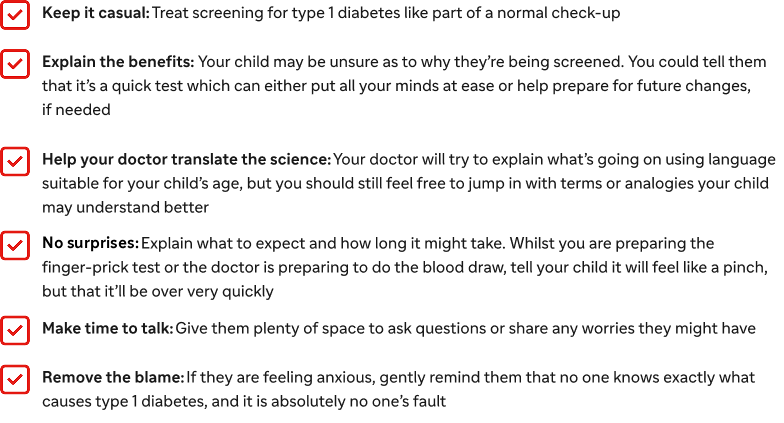
Tips to support your child
Children can have a range of feelings about visiting the doctor. Here are some tips to help your child feel comfortable and supported during their screening appointment:
Key things to remember
- Screening looks for signs that point to early-stage type 1 diabetes
- It’s a quick test requiring just a finger-prick or blood draw
- Learning about whether you have early-stage type 1 diabetes gives you a head start to understand the condition and prepare for managing it before treatment has to start. It can also avoid the risk of serious medical emergencies like DKA
- Don’t wait to get screened. Whether it’s for you or your child, finding out early gives you the time and control you need to look after your or your child’s health
For more information about what your results mean visit:
References
- Insel RA, Dunne JL, Atkinson MA, et al. Diabetes Care. 2015;38(10):1964-1974.
- Ziegler AG, Rewers M, Simell O, et al. JAMA. 2013;309(23):2473-2479.
- Sims EK, Besser REJ, Dayan C, et al. Diabetes. 2022;71(4):610-623.
- Besser REJ, Ng SM, Gregory JW, et al. Arch Dis Child. 2022;107(9):790-795.
- Leslie D, Lipsky P, Notkins AL. J Clin Invest. 2001;108(10):1417-1422.
- Mayo Clinic. Blood sugar testing: Why, when and how. Accessed September, 2026. https://www.mayoclinic.org/diseasesconditions/diabetes/in-depth/blood-sugar/art-20046628
- Breakthrough Type 1 Diabetes. Type 1 Diabetes Early Detection. Accessed September, 2026. https://www.breakthrought1d.org/early-detection/
- Besser REJ, Bell KJ, Couper JJ, et al. Pediatr Diabetes. 2022;23(8):1175-1187.
- Hazime R, Lamjadli S, Guennouni M, et al. Diabetes Epidemiol Manag. 2025;17:100246.
- DiMeglio LA, Evans-Molina C, Oram RA. Lancet. 2018;391(10138):2449-2462.
- Phillip M, Achenbach P, Addala A, et al. Diabetes Care. 2024;47(8):1276-1298.
- Children and Young People’s National Diabetes Network. Accessed September, 2026. https://www.cdep.org.uk/contentdocuments/299/Diabetes-Dont-Miss-The-Diagnosis-1.0.pdf
- Haller MJ, Bell KJ, Besser REJ, et al. Horm Res Paediatr. 2024;97(6):529-545.
- Parkkola A, Härkönen T, Ryhänen SJ, et al. Diabetes Care. 2013;36(2):348-354.
- Allen C, Palta M, D’Alessio DJ. Diabetes. 1991;40(7):831-836.
- Ludvigsson JF, Ludvigsson J, Ekbom A, et al. Diabetes Care. 2006;29(11):2483-2488.
- Skov J, Kuja-Halkola R, Magnusson PKE, et al. Eur J Endocrinol. 2022;186(6):677-685.
- Biondi B, Kahaly GJ, Robertson RP. Endocr Rev. 2019;40(3):789-824.
- Cárdenas-Roldán J, Rojas-Villarraga A, Anaya JM. BMC Med. 2013;11:73.
- Karges B, Prinz N, Placzek K, et al. Diabetes Care. 2021;44(5):1116-1124.
MAT-GLB-2603623-v1.0-09/2026