

Understanding your
screening results
What your results mean and what happens next
Getting screened for type 1 diabetes was the right thing to do. You took a proactive step that will help you better understand and protect your health, or the health of a loved one.
Screening results won’t be ready immediately and may take a few weeks to be processed. It’s
understandable if you feel anxious while you wait for the results. But, whatever the result, getting screened will provide valuable information and more time to understand what comes next.1-3

The results show no autoantibodies
If the screening results show no type 1 diabetes‑related autoantibodies, that’s reassuring news. It means there’s no evidence of early-stage type 1 diabetes at this time.4
While it’s great to have your mind put at ease for now, it’s a good idea to talk to your doctor about getting screened again in the future, especially if you have a family history of type 1 diabetes or other risk factors (like a family history of other autoimmune conditions).4,5
If no type 1 diabetes-related autoantibodies are detected, that means they weren’t present when the screening test was performed. But they can appear later in life, so a risk of type 1 diabetes in the future can’t be completely ruled out.6
Having a close family member with type 1 diabetes increases the risk of having it by up to 15 times compared to those without.3,7,8 So think about autoantibody screening for your loved ones if you’re at all concerned about their chances of developing the condition.
Repeat screening may be recommended for children at higher risk of developing type 1 diabetes. This includes those with high blood glucose (sugar) or a family history of autoimmune conditions.6
Your next step:
Ask your healthcare team how long you should wait before being screened again and make a note in your calendar.

The results show one autoantibody
If the screening results show one type 1 diabetes‑related autoantibody, you or your child may be at higher risk of developing type 1 diabetes in the future.9
Your healthcare team may arrange another test to confirm the result.6,9 Then they’ll take you through what happens next. This will include rescreening in due course and blood glucose monitoring, to keep an eye on any changes.9 This is especially important if you have a family history of type 1 diabetes, or have other risk factors (like a family history of other autoimmune conditions).6
Your next step:
- Ask your healthcare team when your next screening will be and make a note in your calendar
- Ask your healthcare team if you need to start blood glucose monitoring
Remember, if a close family member has type 1 diabetes, your risk can be up to 15 times higher compared to those without.3,7,8 So think about autoantibody screening for your loved ones if you’re at all concerned about their chances of developing the condition.

The results show two or more autoantibodies
If the screening results show two or more different type 1 diabetes‑related autoantibodies, you or your child have early-stage (Stage 1 or 2) type 1 diabetes.6
Your healthcare team will arrange another test to confirm the result. Then they’ll take you through what happens next.6,9 This will include blood glucose checks to determine the specific stage of type 1 diabetes, and also to monitor the condition over time.9
It’s natural to find this result difficult to process and accept.5,10-13 But please remember that you’re not alone. Your doctor will talk you through what it means. They will arrange follow-up tests, explain your options and give you all the support and information you need.
Symptoms to look out for
In the early stages of type 1 diabetes (Stages 1 and 2), symptoms are not noticeable. But over time, as the body starts making less insulin, that’s when signs of high blood glucose can start to appear. 14,15
Symptoms include14:
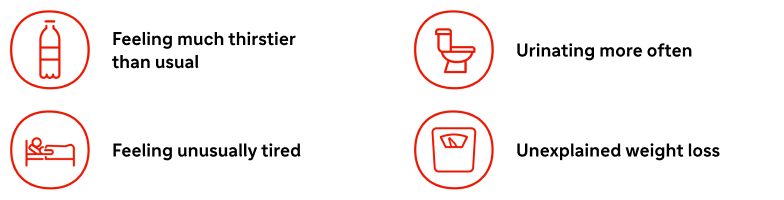
If you or your child notices any of these symptoms, contact your doctor as soon as possible. Recognising symptoms early can help to ensure the right support and treatment are put in place quickly.14,16
Key things to remember
- A screening result showing no type 1 diabetes-related autoantibodies means you or your child are not showing any signs of having type 1 diabetes at this time
- A screening result showing one type 1 diabetes-related autoantibody suggests there may be a higher than usual risk of developing it in the future
- A screening result showing two or more type 1 diabetes-related autoantibodies suggests early-stage type 1 diabetes (Stage 1 or Stage 2)
- If you have any concerns about the screening results or what comes next, your healthcare team are here to help and support
References
- Quinn LM, Rashid R, Narendran P, et al. Br J Gen Pract. 2023;73(726):36-39.
- Quinn LM, Dias RP, Greenfield SM, et al. Diabet Med. 2025;42(5):e15490.
- Besser REJ, Bell KJ, Couper JJ, et al. Pediatr Diabetes. 2022;23(8):1175-1187.
- US Centers for Disease Control and Prevention. Screening for type 1 diabetes. Accessed September, 2026. https://www.cdc.gov/diabetes/diabetes-testing/screening-type-1-diabetes.html
- Sims EK, Besser REJ, Dayan C, et al. Diabetes. 2022;71(4):610-623.
- Moore DJ, Leibel NI, Polonsky W, et al. Int J Gen Med. 2024;17:3003-3014.
- Haller MJ, Bell KJ, Besser REJ, et al. Horm Res Paediatr. 2024;97(6):529-545.
- Parkkola A, Härkönen T, Ryhänen SJ, et al. Diabetes Care. 2013;36(2):348-354.
- Phillip M, Achenbach P, Addala A, et al. Diabetes Care. 2024;47(8):1276-1298.
- Johnson SB, O’Donnell H, Smith LB, et al. Curr Diab Rep. 2025;25(1):57.
- de Wit M, Klinker LY, Moore B, et al. Diabet Med. 2026:e70308.
- Quinn LM, Narendran P, Bhavra K, et al. Pediatr Diabetes. 2024:9927027.
- Collins RE, Lopez LM, Marteau TM. BMC Public Health. 2011;11:603.
- Breakthrough T1D (formerly JDRF). Monitoring Guidance Consumer Handout. Accessed September, 2026. https://www.breakthrought1d.org/wp-content/uploads/2024/11/Breakthrough-T1D-Monitoring-Guidace-Consumer-Handout.pdf
- Diabetes UK. Hot topics – detecting and treating type 1 diabetes early. Accessed September, 2026. https://www.diabetes.org.uk/our-research/about-our-research/hot-topics/can-you-prevent-type-1
- Mayo Clinic. Type 1 diabetes – Diagnosis & treatment. Accessed September, 2026. https://www.mayoclinic.org/diseasesconditions/type-1-diabetes/diagnosis-treatment/drc-20353017
MAT-GLB-2603628-v1.0-09/2026