

Looking after your
child with early-stage
type 1 diabetes
Receiving your child’s screening results can be a lot to take in. It’s completely normal to feel overwhelmed right now but please know you aren’t in this alone. Along with your child's healthcare team, there’s a whole community of parents and caregivers who know exactly what you’re going through. Whether their kids are in the early stages (Stages 1 and 2) or actively managing Stage 3 type 1 diabetes every day, these families are here to share practical tips and everyday advice.
As your child gets older, they’ll naturally start taking on more of their own care, with the guidance of their healthcare team. In the meantime, gently increasing their awareness of symptoms and explaining what is happening in their glucose (sugar) monitoring appointments builds great habits early on. Above all, know that with the right support, your child can continue to enjoy a full and happy childhood.
Starting the conversation with your child’s healthcare team
Because your child’s type 1 diabetes was detected early (in Stage 1 or 2), you have time on your side. This gives you a head start to learn exactly which symptoms to watch for, which can help you avoid medical emergencies like diabetic ketoacidosis (DKA).
Visit the Meet your beta cells page to learn more about DKA.
“We are not aware of any diabetes in the family…She was very thirsty…She threw up several times. We thought it was just dizziness, but it was because of diabetic ketoacidosis...I will stress the importance of knowing the symptoms [of any condition].”
It also gives you time to learn how to check and eventually manage their blood glucose levels at your own pace, all while working closely with your child’s healthcare team to create the best care plan for them.1
Now that you have your child’s test results, you’re probably wondering, “What happens next?” At your next appointment, your child’s healthcare team will sit down with you to walk through what to expect, including these next steps:
- Explain what your child’s result means
- Run a few routine blood tests and work out a glucose monitoring plan
- Answer any questions you may have so you know exactly what to do next
How to make the most of your child’s appointments
Doctor’s appointments can sometimes feel like information overload. Writing your questions down before you go is a great way to make sure you don’t forget anything important. Here are a few common questions other parents find helpful to ask:
- Who are the key people in my child’s healthcare team?
- Are there local or online support groups you recommend?
- What is the best way to keep my child’s school informed?
- What can we expect next, and will their condition change over time?
- What are the signs that they might be moving into the next stage of type 1 diabetes?
- How exactly do we monitor their blood glucose?

Monitoring your child’s blood glucose levels
Every child’s journey with early-stage type 1 diabetes is a little different. It can develop quickly (over weeks to a few months) for some and much more slowly (over several years) for others.1-3 Because of this, checking your child’s blood glucose regularly is incredibly important. Doing this allows you to:
- easily track their overall health and notice any patterns4
- stay one step ahead of medical emergencies like diabetic ketoacidosis (DKA) before they happen1
- work with your child’s doctors to pinpoint the right time to introduce insulin (starting insulin is a sign that they’ve entered Stage 3, the phase where symptoms become noticeable)5,6
Blood glucose levels are affected by many factors7:
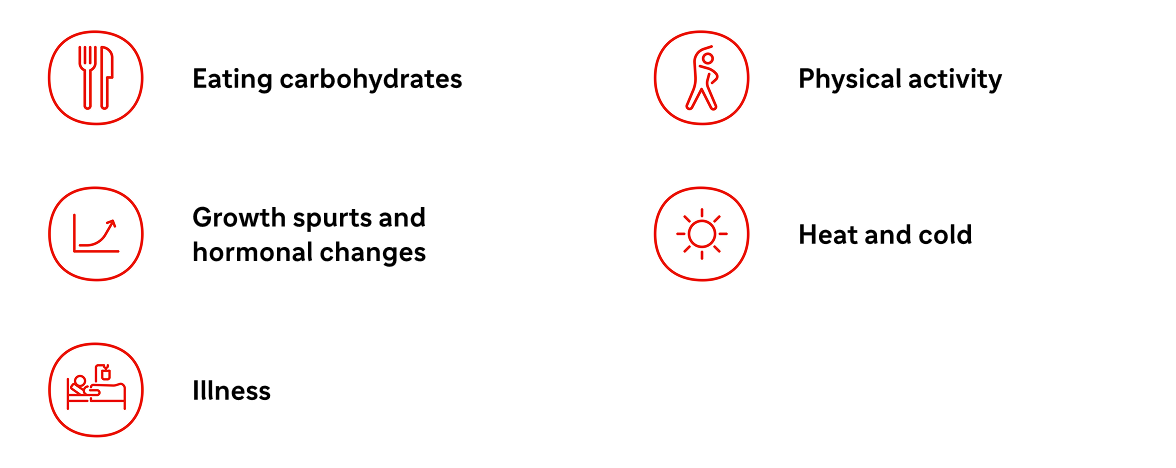
That’s why staying on top of these checks is so important. Fortunately, there are several different ways to monitor blood glucose and how type 1 diabetes is changing over time.7 As these options depend on what stage your child is at with their condition, your child’s healthcare team will find the option that suits your child’s needs best.

Blood glucose meter
The classic approach. With a quick finger-prick, you get a highly accurate blood glucose reading in seconds

Continuous blood glucose monitor (CGM)
A small wearable sensor that does the checking for you. It sits comfortably on your
child’s skin and sends their blood glucose numbers directly to your phone, 24/7

Flash glucose monitoring
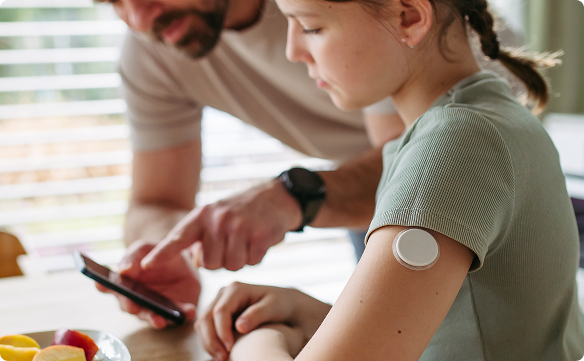
A small sensor worn on the arm that lets you check levels in a flash. Just swipe your phone or a reader over the sensor to get a reading whenever you need one

Other in-clinic blood tests
For instance, to measure average blood glucose levels over time, or how much insulin your child’s pancreas is producing
Talk to your child’s doctor about which monitoring plan makes the most sense for your family’s routine. To help you get ready, be sure to download the type 1 diabetes companion guide below, which includes information about glucose monitoring.
Not sure what to ask when you get there? Here are a few helpful questions to jot down7:
- How often should we be checking blood glucose?
- What is my child’s ideal blood glucose target?
- What if my child’s numbers are outside of the target?
- What are some tips to help my child feel more comfortable during the finger-prick blood tests?
Support is available
We know this journey can feel overwhelming, so we created a tool below to help make day-to-day life a little easier for parents and caregivers of children with early-stage type 1 diabetes.
Download this handy type 1 diabetes companion guide to learn more about:
- what your child’s screening results mean
- why monitoring blood glucose is important
- what symptoms and signs to keep an eye out for
- where to find emotional and practical support for your whole family

Key things to remember
- You are never alone in this. It is completely normal to feel worried or overwhelmed after finding out your child has early-stage type 1 diabetes. Just remember that your child’s healthcare team and the type 1 diabetes community are always here to support your whole family
- Early detection is an advantage. You have a valuable head start to learn the about glucose monitoring and to know exactly what signs to watch out for
- Checking numbers gives you power. Taking your child to their clinic appointments so your healthcare team can keep an eye on your child’s blood glucose and adjust their care plan helps keep them healthy
References
- Moore DJ, Leibel NI, Polonsky W, et al. Int J Gen Med. 2024;17:3003-3014.
- Krischer JP, Type 1 Diabetes TrialNet Study Group. Diabetologia. 2013;56(9):1919-1924.
- Ziegler AG, Danne T, Daniel C, et al. Med (N Y). 2021;2(10):1120-1137.
- US Centers for Disease Prevention and Control. Monitoring your blood sugar. Accessed September, 2026. https://www.cdc.gov/diabetes/diabetes-testing/monitoring-blood-sugar.html
- Scheiner G, Weiner S, Kruger DF, et al. ADCES in Practice. 2022;10(5):20-25.
- Breakthrough T1D. The stages of type 1 diabetes. Accessed September, 2026. https://breakthrought1d.org.au/early-detectionof-type-1-diabetes/stages/
- Breakthrough T1D. Managing your child’s blood glucose levels. Accessed September, 2026. https://breakthrought1d.org.uk/knowledge-support/guide-for-parents/managing-your-childs-type-1-diabetes/managing-your-childs-blood-glucose-levels/
MAT-GLB-2603952-v1.0-09/2026